





Overview
- AI adoption in B2B marketing is now mainstream and accelerating: The vast majority of B2B marketers are already using or testing AI, with over 80% planning deeper integration. Leaders believe AI drives revenue growth, efficiency, personalization, and better buyer experiences—making it a competitive necessity rather than an experiment.
- AI directly correlates with stronger performance and productivity: Marketers using AI are far more likely to beat their targets, supported by gains in revenue growth, cost reduction, and productivity. AI’s biggest impacts are in analytics, content creation, audience segmentation, and automation—freeing teams to focus on higher-value strategy.
- Content and webinars are the biggest value multipliers for AI today: AI is most widely used to scale promotional and non-promotional content and to extract more value from webinars through personalization, analytics, and content repurposing. This allows marketers to meet rising content demands while extending the lifecycle and ROI of existing assets.
Artificial intelligence is no longer a speculative trend in B2B marketing; it’s now a standard, though relatively new, tool that digital marketers are using to run marketing experiments, accelerate internal workflows, and drive hyper-personalization at a scale never before seen.
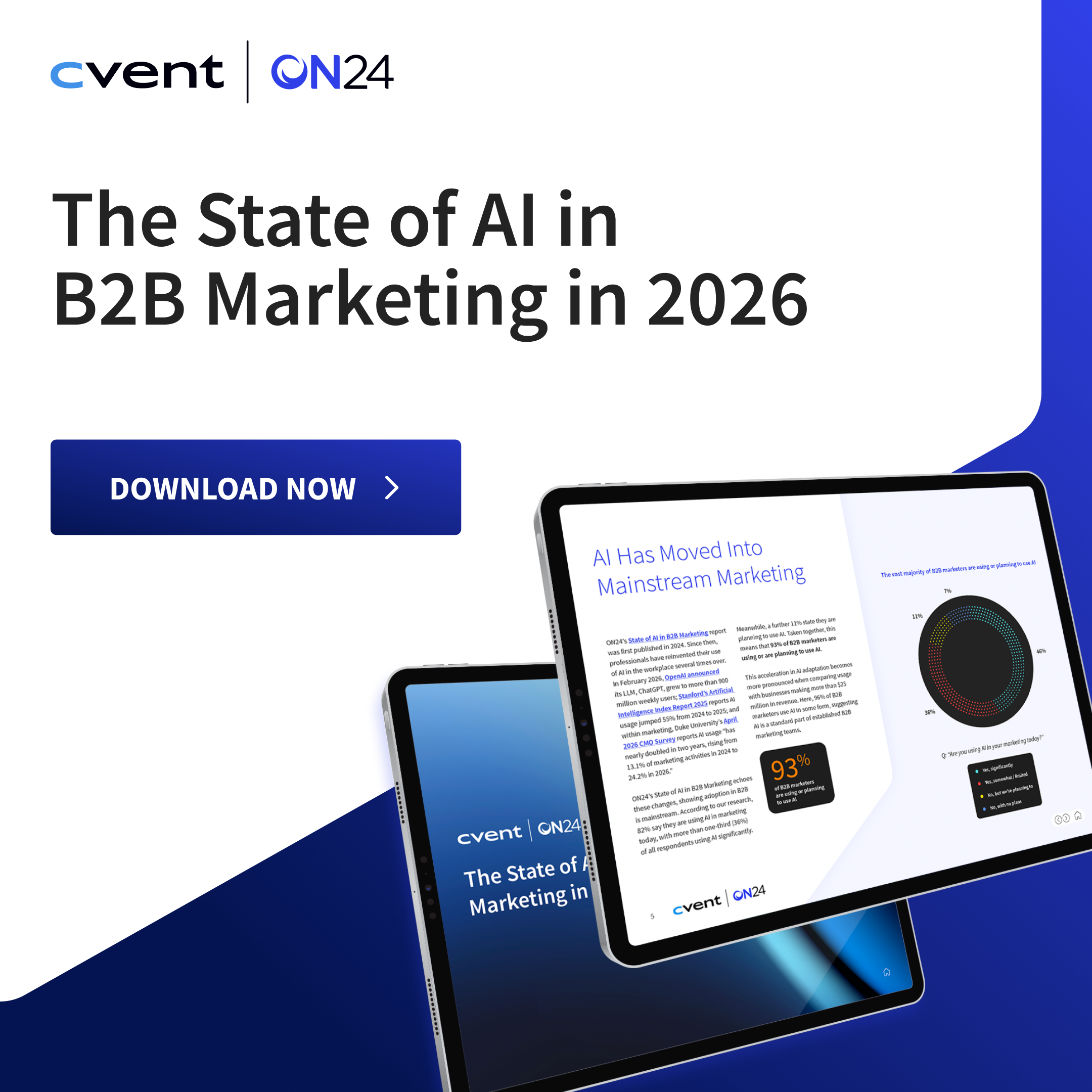
So how are B2B marketers adapting to the AI era? To find out, ON24 surveyed more than 250 B2B marketers across the United States to understand how teams are using AI tools and how marketers think AI will impact the industry in the future. The findings are compiled in our special report, The State of AI in B2B Marketing in 2026.
Top AI trends for B2B marketers
When it comes to the continued adoption of B2B AI tools, ON24 has found that:
-
- 91% of top-performing businesses are planning for more AI initiatives
- 89% of top-performing businesses plan to implement more AI activity in 2026
- 75% of heavy AI users report boosts to overall productivity
- 65% of top-performing businesses report major team productivity gains
- 42% of B2B marketers believe AI can help improve workflows, their top challenge
We also found that:
-
- 96% of significant AI users are planning to expand AI implementation
- 71% of B2B report AI has had a positive impact on webinar performance
AI Has Moved Into Mainstream B2B Marketing

A lot of things have changed since our previous State of AI report in 2024. AI, the colloquial term for a family of technologies such as LLMs, has surpassed more than a billion monthly users. B2B marketers now use the technology to draft emails, e-books, create images, clip videos, transcribe audio, draft slide decks, segment audiences, and much, much more.
It should be no surprise, then, that 93% of B2B marketers report they are either using or planning to use AI in their marketing operations. For businesses making more than $25 million in annual revenue, that figure goes up to 96% — suggesting AI is now standardized in at least some established organizations.
B2B marketing challenges are aligned to the AI moment
That AI tools are a boon to professional productivity is no secret. B2B marketers, in particular, are primed to take advantage of these platforms due to the increasingly acute challenges they face. For example, workloads (42%) were found to be the top challenge for today’s B2B marketer, with a lack of budget and resources (37%) a close second.
AI can help marketers rethink their workflows by offloading routine, well-established tasks. Platforms can also help teams automate workflows, such as downloading and transcribing audio files, using agentic agents. By accelerating these tasks, professionals can examine, test, and prioritize internal optimizations.
Why AI is essential to getting more value from webinars
AI presents a unique opportunity for B2B marketers to extract even more value from webinars, virtual conferences, and digital events. On average, webinar attendees spend 53 minutes watching a single session. That translates into about 10,000 words of spoken content.
That’s content marketers can tap into and repurpose for other formats with the help of generative AI. Just look at what one thought-leadership webinar can become when AI is put to work:
-
- Social posts using speaker quotes from the webinar transcripts
- Blogs and e-books created by AI using key findings or highlights
- Short video clips of key moments of audience engagement identified by AI-powered analytics
Increased AI Use Correlates with Stronger Performance and Productivity

We all know AI can theoretically help boost productivity and help marketers to get more done with less. But are B2B marketers actually seeing that promise realized in both their day-to-day work and at an organizational level?
Turns out, yes.
According to our survey, 56% of organizations reporting significant AI usage also exceeded their top business goals by a significant margin. This shows a strong correlation between AI sophistication and business outcomes.
This correlation also holds true across different studies. For example, a 2025 IDC study found that top-performing firms were four times as likely to report top-line growth.
For individual users, the link between significant AI usage and higher productivity is even more drastic. In fact, 96% of significant AI users report being at least somewhat more productive than they’d be otherwise. An astounding 75% of that cohort say they’re significantly more productive.
AI Practice in B2B Marketing Lags Potential

Businesses and individual professionals are seeing measurable boosts in productivity and efficiency simply by using AI. But the future benefits of AI aren’t limited to rote one-off tasks, questions, and similar brainstorming activities. Future productivity winners will go a step further by understanding how AI can be integrated, optimized, and enhanced into marketing workflows.
In fact, when asked, many marketers in our survey report that while they can see AI’s potential within their organization and marketing specialization, few are actually implementing the technology. Our survey found stark gaps between perceived AI impact and actual use. These gaps include:
- 54% Language translation
- 53% webinars and virtual events
- 39% Analytics and measurement
- 27% Physical events
- 29% Creative/design
A good deal of these deltas may come down to nuances within a specialization and overall AI sophistication within an organization. Facets of a language, for example, can be difficult to parse out for someone who isn’t a native speaker. The lack of AI use in webinars and virtual events may also indicate organizational caution about implementing a multi-stage AI workflow across teams.
This AI hesitancy won’t last as teams become more familiar with these tools and start rethinking their overall workflows with AI in mind.
First-party data practices hold back personalization at scale
The opportunity use AI to personalize content and experiences is one of the more exciting prospects that marketers love to discuss. But before AI can deliver on the personalization promise, B2B marketers need to ensure their data is in order — especially first-party data.
Survey respondents report that — while they believe AI personalization can drive positive outcomes like improved engagement (62%), scale (49%), and accelerated conversion (47%) — only 39% leverage AI for personalization.
The key limiter here isn’t the desire to use AI, but rather the lack of quality, vetted data necessary to power hyper-personalization at scale. For example, our survey found that only 45% of B2B marketers used data related to specific named accounts. Other forms of data, such as form-fills (31%), engagement history (30%), and buyer stage (29%), fare worse.
If marketers are going to make personalization a reality, they need to develop plans and workflows for the other half of the AI equation: their data.
The Future of B2B Marketing in an AI Era

So what does the next stage of AI in marketing look like? It’ll likely involve a combination of elements in the buyer journey that talk to one another. We’ll likely see human-to-human contact continue as it always has, but it’ll be buttressed by new combinations of human-to-AI and AI-to-AI interactions.
According to our survey, respondents believe the use of AI in the B2B marketing arena will likely enable marketers to act on buyer insights faster (79%) and make marketing automation more efficient (78%).
But these proposed boons require marketers to develop, test, and implement operating models that have AI integrated throughout. It also requires having an idea of what “good” is with AI. According to our report, significant AI users are more likely to connect AI investments to better overall business results. That matters because it moves AI success past superficial outputs (hours saved, content drafted) and towards how prospects engage with a brand (e.g., conversions, form fills, pipeline, etc.).
But it all starts with planning. Teams need to test AI within their workflows. That means defining a pilot program, selecting an approved data source, appointing team members to review duty, and regular assessments before using AI to scale impact.
To learn what else your fellow B2B marketers are saying about AI and how you can scale AI impact, download The State of AI in B2B Marketing 2026 today.
FAQ: What are the benefits of AI in B2B marketing?
Here are four of the most compelling reasons to integrate AI in the B2B marketing process:
Enhanced lead generation
AI can positively impact B2B lead generation by helping marketers create and deploy more effective campaigns. There are various ways to integrate AI in lead generation campaigns, including optimizations in audience segmentation, content creation, personalization and data analysis processes.
Personalization at scale
Personalization in B2B marketing can drive significantly improved results, and AI can help make it easier to roll out at scale. Of particular note is AI’s ability to generate diverse personalized marketing messages and content tailored to suit different audience segments, which can drive higher engagement and conversion rates.
With the AI-powered ACE, a feature of the ON24 Intelligent Engagement Platform, users can quickly identify audience segments and target them with personalized content marketing experiences powered by generative AI.
Data-driven decision-making
AI-powered analytics tools can deliver critical, actionable marketing insights automatically, helping teams quickly improve campaign performance. Integrating AI into the marketing analysis or reporting process allows B2B marketers to make data-driven decisions that more reliably boost marketing results.
Scale content creation
Creating effective B2B marketing content at scale takes a lot of resources, which can limit marketers’ ambitions and hold them back from achieving outstanding results. AI is perfectly suited to solving this problem, making it easier than ever to ideate and produce vast amounts of marketing content.
This includes blog posts, white papers, social media posts, newsletters, and more, all of which can be used in impactful multichannel campaigns. Certain AI tools, like the ON24 platform’s AI-powered Analytics and Content Engine, can also adapt existing marketing resources, like webinars, into other mediums.
How B2B marketers can use AI
There are countless ways AI in marketing can strengthen B2B campaigns. These are some of the most powerful:
Use Predictive Analytics for Sales and Marketing
Sophisticated predictive analytics can help marketers make better, data-driven decisions that increase marketing ROI. B2B marketers can use AI to improve the accuracy and convenience of their predictive analytics process, meaning they can get more value from their marketing data.
There are various ways to integrate AI in predictive analytics, including forecasting customer behavior, automatically scoring leads based on pre-defined criteria, or optimizing sales processes to suit unfolding trends in your target audience’s sectors.
Enhance Customer Experience with AI Chatbots
High standards of customer service can help maximize customer experience, which in turn can improve customer loyalty and lifetime value. But with B2B demand often coming from across the globe, providing comprehensive, always-on customer service can be costly.
AI chatbots provide an alternative to building out a huge customer service team, providing a highly knowledgeable contact point available 24/7, no matter where your audience is. Even if you prefer to keep your support human-led, AI-powered chatbots are great at screening inquiries.
Improved customer retention
B2B marketers can also use AI technology to improve their customer retention strategy, allowing them to maximize customer lifetime value and, by extension, marketing revenue.
There are various ways that AI can boost retention, including by powering personalization in customer communications, enabling always-on customer support, and delivering predictive analytics to inform program optimizations.
Emerging AI Technologies
Ultimately, AI’s use cases in B2B marketing are currently mainly driven by generalized chatbots like ChatGPT and dedicated AI-powered marketing tools like ON24. But, just like any other technology, AI will continue to develop.
That means there are plenty of new B2B marketing applications to come, which will leverage AI’s versatility to support B2B marketers in even more ways. Some of these applications, such as AI-powered voice search and customer support bots, are already emerging.