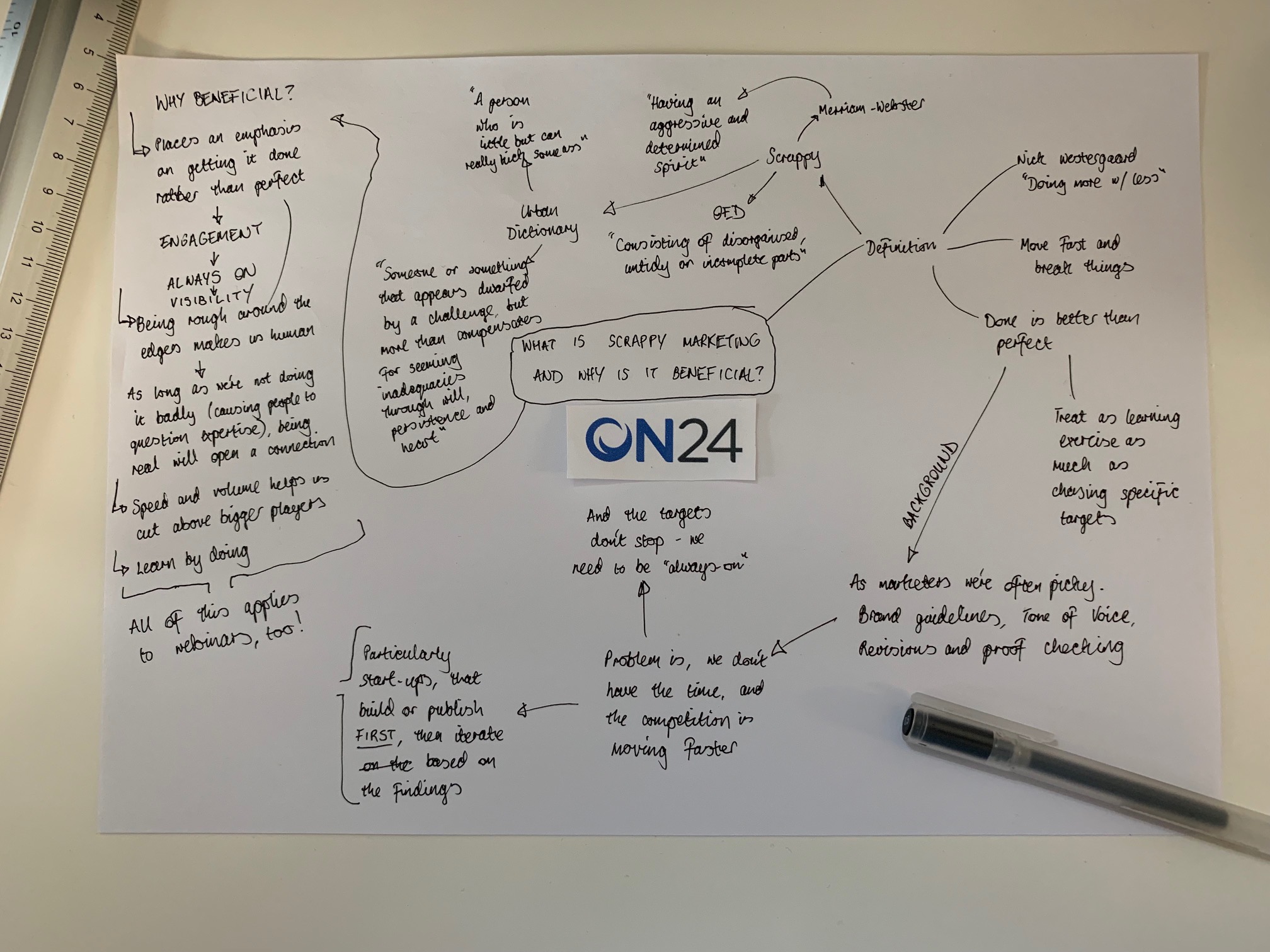





As marketers, we can be a picky bunch. In an effort to put our best foot forward, we often use brand guidelines, tone-of-voice documents, and documented approval processes. We check and double check our work, asking for everyone to go over a fine-tuned piece of copy.
In an age where a print ad, a brochure or a quarterly thought leadership article in the trade press was all that needed to happen, getting things perfect was a noble goal. There’s no way to edit a magazine after it’s been printed.
But in today’s digital age, we simply don’t have the time to do all of this. Targets don’t wait while we revise a whitepaper, and our colleagues in sales aren’t going to hold back from reaching out to prospects in the absence of perfect collateral.
And to add to this, startups and new competitors don’t wait either. Content now needs to be always on to stand above the noise. So what approach should we be taking?
What is scrappy marketing – and is it an answer?
Nick Westergaard, author of the book Get Scrappy and someone who also quotes from Urban Dictionary, says that a scrappy approach to marketing is simply “doing more with less”.
Standing out above the noise in the digital age requires persistence and determination — particularly when going against better-established peers and competitors. It’s about being creative, finding out ways to get the most out of your marketing efforts even when you don’t have all the answers.
In short — if you’re limited on time and resource, but still want to achieve great results – scrappy marketing is an approach you should be taking.
Why is scrappy marketing beneficial?
Here are a few reasons why being scrappy can benefit your marketing team.
It places an emphasis on getting it done, rather than being perfect
As scrappy methods are more likely to result in marketing being available more quickly and at higher volume, they fit more closely with how prospects start their own buying journeys. Any moment spent waiting to publish is a moment where a prospect could be consuming your content.
The more innovative you are, the more robust you are – you can roll with the punches that will inevitably come in a rapidly changing market.
To be innovative, you must foster a culture of experimentation. This means testing ideas quickly, and failing fast so you know what to do next – there’s no lingering over something that doesn’t work, and that will never work.
However, creativity in a business can only blossom if individuals aren’t afraid to fail. Sara Critchfield, founding editorial director of Upworthy, reportedly the fastest-growing media company of all time, says that in order to encourage a team to be more innovative, there must be a shift from a “best practices” mentality to a dynamic “laboratory” mentality, and that team members rather than managers should be made responsible for the results.
She also advocates “normalizing” failure by setting a baseline failure rate and success rate, and measuring the team’s work by that baseline.
It helps you to learn by building campaigns
One of the most common models now being adopted is that popularised in the book The Lean Startup by Eric Ries. The approach emphasizes that the most effective way to learn about a new product is to get it to a minimally-viable version to market, measure its performance, and apply the findings to future iterations.
The same is true for marketing. By running campaigns quickly and measuring their performance, you can use this data to improve the next time you do it.
You can also learn about the tools and technology as you do so, meaning you and your teams becomes more efficient over time.
Speed, volume and personality helps you to cut above bigger players
While the competition will loom large, if you can connect with your audience more frequently by taking a more nimble approach — and showcase your personality while doing so — you can build greater engagement with them, increasing the chance that you will be on their short list when considering a solution.
But keeping up a consistent and fast pace can be a challenge. Fortunately, people love the underdog — as highlighted in a study featured in the Harvard Business Review, which demonstrated that buyers naturally gravitate towards underdog brands, particularly if they too feel a sense of struggling in tough circumstances.
Taking an underdog approach can endear you with your customers and help your team to keep going even when it’s tough. The underdog is always looking for different ways they can win the game. They’re looking for a competitive edge, because they can’t rely on their size, or reputation, or firepower. They’re more resourceful. By definition, they’re more agile.
Being rough around the edges makes us human
Nobody is perfect — so if we’re looking to build genuine connections with people, why should our marketing be perfect?
By demonstrating our vulnerabilities and being open about them, we can start to market in a way that makes our buyers more receptive to our efforts at building a connection.
What are the barriers to being scrappy?
Of course, there can be things that stand in the way of getting scrappy. This is especially true if you work in a sector that is heavily regulated, where sign off is required and can slow the process down.
Get Buy-In for a Scrappy Approach
Resistance to change will be your biggest stumbling block when it comes to introducing the scrappy method, so before doing anything, ensure everyone in the team is on board.
According to Kotter’s Change Model, which provides eight overlapping steps for effecting change in an organization, you must first create urgency, which you might do by identifying potential threats, or opportunities to exploit.
This is followed by building a coalition, which would involve identifying who must lead the change, and ensuring the team is made of a mix of people from different levels of the business, who have different capabilities. Kotter’s model applies more to larger projects, but there are certainly some ideas that you can take from it.
Using data can be a great way to both drive urgency and build support. Look for spikes or dips in your analytics or engagement data, which can help spur on what could happen if you did something outside the norm. Share these around and ask questions to get people to think differently. Get people excited about the potential for better results while encouraging them to start taking action.
Where should you start?
Use data to inspire your campaign ideas. Take advantage of external data such as Google Autocomplete and social data along with the customer data you have, including engagement metrics and questions from your customers. Don’t forget to ask your sales team because they will know what your customers are saying they need.
From there, start getting creative and use some scrappy tactics like micro-campaigns and COPE (create once, publish everywhere) to get your marketing out there.
Take Advantage of Reusable, Repeatable Formats
There will inevitably be days when members of your team aren’t feeling as productive as they would like or have a lot of other priorities depleting their mental energy.
Trying to reinvent the wheel each time will simply lead to reduced performance. Instead, you should look at what reusable and repeatable formats you can run that follow a given formula. The formula should be structured enough that it requires minimal effort to put things into place.
Furthermore, if you schedule these reusable formats, it makes planning your demand generation and marketing activity (and predicting results) far easier, leaving you with more time to experiment on different approaches.
While running webinars initially may take more time than other marketing approaches such as sending out an email newsletter or posting something on social media, there are also webinar formats that are quick to run – such as panel sessions, demos and interviews.
But an important point — make sure to experiment within these regular formats. Always be looking for interesting ways to liven them up or novel approaches to generate better results.
Additionally, Simon Hurrell at The Croc, reminded us that, to do scrappy marketing properly, it’s important to focus on a specific audience instead of trying to engage an array of stakeholders.
“Focus on one particular audience, really understand how you can engage them, what type of value add you want to bring to that particular engagement and how you want to move them forward. Don’t think about trying to cover every single scenario, in every single channel, focus on the channel where your audiences are and then make sure you will find something of value to give to them.”
How does this apply to webinars?
Webinars are a great place to start with a scrappy approach to marketing. You can put yourself in front of an audience, engage with them in real-time, and learn how to do it better next time.
In addition, webinar content can be repurposed, made available on-demand, and provide a rich source of data for both sales intelligence and marketing insight. Simon explains that ultimately, data is important.
“If we haven’t got data, we can’t work quickly. To do that, you need to have an agreement about what you want to measure at the beginning of your adoption for this methodology and making sure you’re then just refining and adding to that as it goes through.”
And if you’re already running webinars, going scrappy can act as an interesting method to driving up the volume of your content and lifting your results.
Finally — is this article scrappy?
Yes, it is! As proof, find below the notes that were written in putting this together — and enabled this post to reach you in quick time.